
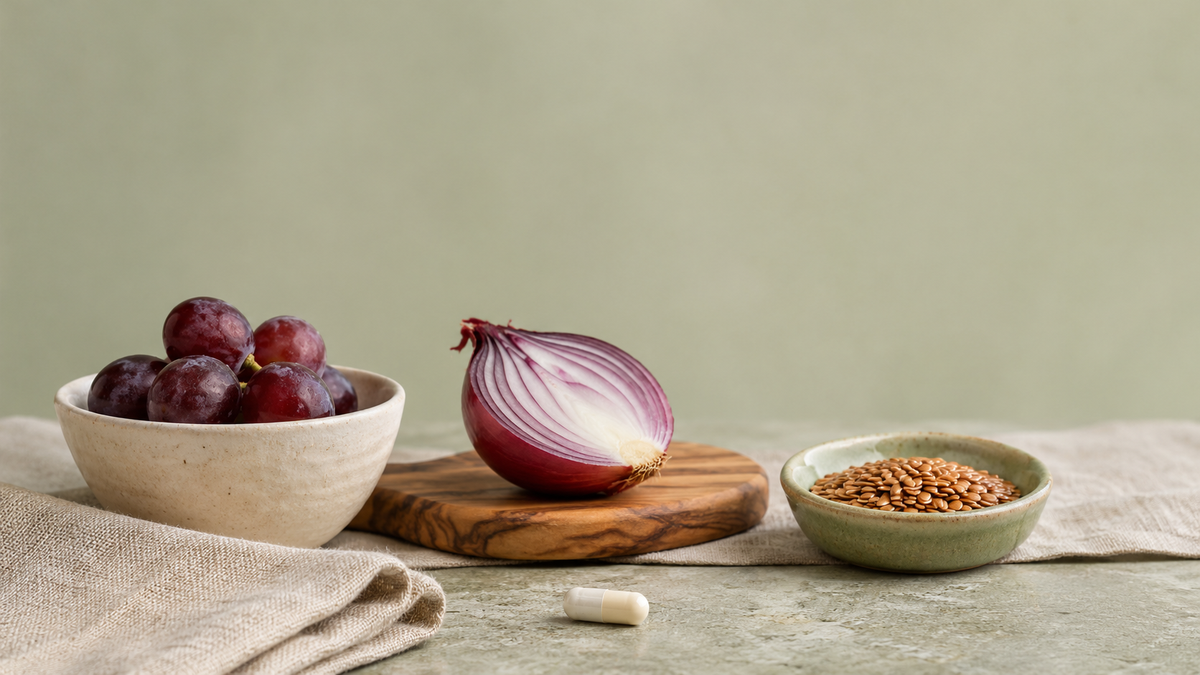
Akkermansia Foods: What Actually Raises Your Levels
In this article
There are no true Akkermansia foods: no ordinary food contains meaningful amounts of live Akkermansia muciniphila, because this bacterium lives in the mucus layer lining your gut, not in yogurt, kefir or sauerkraut. When people search for Akkermansia foods, what they need are foods linked to higher levels of the Akkermansia they already carry, and the best-studied candidates are polyphenol-rich foods such as grapes, cranberries, pomegranate and green tea, plus fermentable fibers such as inulin.
Much of that evidence comes from mice and rats. The human studies are small and short, though a few point the same way. Below is what each food rests on, what was shown in people versus animals, and where a supplement fits.
What foods contain Akkermansia?
Practically none. Akkermansia muciniphila was first isolated from human stool in 2004 by researchers in the Netherlands, who described it as strictly anaerobic, meaning it does not tolerate oxygen, and able to live on mucin as its only source of carbon and nitrogen. Mucin is the main building block of the mucus that coats the gut lining, and that mucus layer is where Akkermansia makes its home.
That sets it apart from the lactic acid bacteria used to make yogurt, kefir and sauerkraut. So the useful question is not which foods contain Akkermansia, but which foods help the Akkermansia already in your gut. If you are new to this bacterium, our simple guide to Akkermansia muciniphila covers the basics.
Which foods are linked to more Akkermansia?
Here is how the main food groups compare, from the strongest evidence in people to findings seen only in animals.
| Food group | Examples | Strongest evidence (human or animal) | What was measured |
|---|---|---|---|
| Grapes | Table grapes, Concord grapes, whole grape powder | Human: one small pilot study of 19 adults with no placebo group, plus a mouse study | Akkermansia in stool rose after 4 weeks of grape powder |
| Everyday fermentable carbs (FODMAPs) | Onions, garlic, wheat, beans, lentils | Human: one crossover trial in 33 adults | Relative Akkermansia about 19 times higher on a typical diet than on the usual diet |
| Inulin-type fibers | Chicory root, Jerusalem artichoke, onions, leeks, asparagus | Mixed: mice, plus small human trials with different results | Akkermansia rose in mice and in 12 adults on dialysis; no rise reported in 30 women |
| Pomegranate | Pomegranate, pomegranate extract | Human: one small study of 20 adults, association only | Akkermansia 33 to 47 times higher in people who turn pomegranate compounds into urolithin A |
| Cranberry | Cranberries, cranberry extract | Mostly animal (mice); one tiny human study with no control group was inconclusive | In mice, the share of Akkermansia in gut bacteria rose on a high-fat, high-sugar diet |
| Green tea | Green tea, green tea catechins | Animal only (rats) | Akkermansia rose in rats on a high-fat diet |
Two patterns stand out. The most dramatic results come from rodents fed high-fat diets, which is a long way from a person eating a bowl of grapes. And the human results measure the share of Akkermansia in a stool sample, not anything you would feel.
Polyphenols and Akkermansia: what the studies show
Polyphenols are plant compounds that give berries, grapes and tea much of their color and bitterness. Most are poorly absorbed, so much of what you eat travels on to the colon, where gut bacteria meet it. That is one reason researchers suspect polyphenols act partly through the microbiome.
Cranberry. In a 2015 mouse study from Quebec, mice on a high-fat, high-sugar diet received a polyphenol-rich cranberry extract (200 mg per kg of body weight) daily for eight weeks. The extract markedly increased the proportion of Akkermansia in their gut bacteria. A 2017 follow-up by the same group saw a similar Akkermansia bloom when the extract was given to mice that had already spent 13 weeks on that diet. Human data are thin: in a 2017 study with no control group, 10 healthy adults ate 42 g of sweetened dried cranberries daily for two weeks, and Akkermansia rose in 7 of the 9 who carried it, a trend that was not statistically significant.
Grapes. In a 2015 mouse study, adding Concord grape polyphenols at 1 percent of a high-fat diet dramatically increased the growth of Akkermansia. The human data are smaller. In a 2021 pilot study at UCLA, funded by the California Table Grape Commission, 19 healthy adults aged 21 to 55 first ate a low-fiber, low-polyphenol diet for four weeks, then added 46 g of freeze-dried whole grape powder a day, about two servings of table grapes, for four more weeks. Akkermansia rose significantly compared with the start. There was no placebo group, so it is an early signal rather than proof.
Pomegranate. In a 2015 study, 20 healthy adults took 1,000 mg of pomegranate extract daily for four weeks. People whose gut bacteria turned pomegranate compounds into a metabolite called urolithin A had 33 times more Akkermansia at the start and 47 times more after four weeks than people who did not make it. That shows a link between Akkermansia and how a person processes pomegranate, not that pomegranate raised it.
Green tea. The support here is animal only. In a 2023 study in rats on a high-fat diet, an extract rich in green tea catechins, tested at two doses, promoted Akkermansia muciniphila. Concentrated extracts given to rats do not translate neatly into cups of tea.
Does fiber feed Akkermansia?
Not directly, as far as we know. In the 2004 lab work, Akkermansia grew best on mucin and could use only a few simple sugars, and only when protein was also available. Fiber seems to help indirectly, by feeding the wider community of gut bacteria and supporting the mucus layer that Akkermansia depends on.
In mice, the link is clear. A 2013 study found Akkermansia was lower in mice with obesity, and that feeding a prebiotic fiber brought it back to normal levels.
In people, results are mixed. In a 2013 Belgian trial, 30 women with obesity took 16 g a day of inulin-type fructans (a 50/50 mix of inulin and oligofructose) or a placebo powder for three months. The fiber raised Bifidobacterium and Faecalibacterium prausnitzii, two other bacteria considered beneficial, but the study summary does not report a rise in Akkermansia. In a small 2021 crossover trial, 12 adults on hemodialysis took 10 to 15 g of inulin a day for four weeks, and the share of Akkermansia rose compared with a placebo powder.
The wider family of fermentable carbohydrates also matters. In a 2015 crossover trial in Australia, 33 adults, 27 with irritable bowel syndrome and 6 without, ate two provided diets for 21 days each: one low in FODMAPs, a group of fermentable carbohydrates found in foods such as onions, garlic, wheat and beans, and one with typical amounts. Compared with their usual diet, the typical diet raised the relative abundance of Akkermansia muciniphila about 19-fold, while the low-FODMAP diet reduced total bacterial numbers. If a clinician has prescribed a low-FODMAP diet for you, keep following that plan and discuss any change with them.
Fiber protects the mucus layer in another way. In a 2016 mouse study, when fiber was removed from the diet, gut bacteria turned to the mucus layer itself for food and wore it down. Feeding your gut bacteria fiber is part of looking after the place Akkermansia lives. The same fermentable fibers are also what gut bacteria turn into butyrate, as we cover in our guide to foods high in butyrate.
How to increase Akkermansia naturally
A 2019 systematic review gathered 29 clinical trials with 1,444 participants, 11 of which measured Akkermansia. Pomegranate extract, resveratrol, polydextrose and inulin increased Akkermansia in some of those trials, and a low-FODMAP diet decreased it, but the authors judged the evidence unclear and called for more research. With that in mind, here is a reasonable, food-first approach:
- Eat colorful polyphenol-rich foods most days. Grapes, cranberries and other berries, pomegranate and green tea are the most studied. Whole foods bring fiber along with the polyphenols.
- Include fermentable fibers. Onions, garlic, leeks, asparagus, beans, lentils and chicory root are good sources.
- Increase fiber slowly. In the 2013 inulin trial, 14 of 15 women taking the fiber had slight bloating, gas or abdominal pain at the start, compared with 6 of 15 on placebo, and it faded within a few days for most. That trial used a half dose for the first week.
- Think in weeks, not days. The human studies above ran from two weeks to three months of steady intake.
- Do not chase a single test number. One stool test is a snapshot, as we explain in what low Akkermansia on a gut test actually means.
Akkermansia foods vs an Akkermansia supplement
Foods and supplements do different jobs. Foods may help the Akkermansia you already carry, but they cannot add a strain that is not there. A supplement adds the strain itself, and food helps feed the environment it lands in. As a physician, I see them as partners rather than alternatives.
Butyrate fits the same picture, since it is a main fuel for the cells lining the colon. If you are considering both, our guide to taking tributyrin and Akkermansia together walks through how they pair.
Who should check with a physician first
Adding these foods is reasonable for most people. Check with your physician before adding a probiotic or concentrated fruit or tea extracts if you are pregnant or breastfeeding, have a weakened immune system or take immunosuppressive medication, are considering it for a child, take prescription medication such as blood thinners, follow a prescribed diet such as a low-FODMAP or kidney diet, or have a digestive or other ongoing health condition. New bloating or pain that lasts more than a couple of weeks, blood in the stool, or a lasting change in bowel habits deserves a visit, whatever you are eating.
How Vita Bloom fits
| Product | Vita Bloom Labs Akkermansia Muciniphila Probiotic (Gut Health) |
|---|---|
| Per serving | Akkermansia muciniphila, 1 billion AFU (active fluorescent units), microencapsulated |
| Serving and form | 1 capsule, vegetable cellulose (vegetarian), unflavored; 30 capsules, 30 servings |
| How to take | One capsule daily with food, up to two a day. |
Foods may help the Akkermansia you already carry. Our Akkermansia Muciniphila Probiotic adds the strain itself, 1 billion AFU of live, microencapsulated Akkermansia muciniphila per capsule, and supports the gut lining and a healthy gut barrier.* Take one capsule daily with food, up to two a day, and give it at least 4 to 8 weeks of consistent use. It also stacks well with our Tributyrin.
Frequently asked questions
What foods contain Akkermansia?
No ordinary food contains meaningful amounts of live Akkermansia muciniphila. It lives in the mucus layer of the gut and does not tolerate oxygen, so the aim is to eat foods that help the Akkermansia you already carry.
Which foods increase Akkermansia the most?
In people, the clearest early signals come from grape powder and from diets with typical amounts of fermentable carbohydrates, both in small studies. The cranberry and green tea results so far come mainly from animals.
Do yogurt, kefir or other probiotic foods contain Akkermansia?
No. Those foods are made with other bacteria, mainly lactic acid bacteria. To take Akkermansia itself, you need a supplement that lists it on the label.
How long does it take for food to change Akkermansia levels?
The human studies that found a clear rise in Akkermansia measured it after three to four weeks of steady intake. Results vary from person to person, and one stool test is only a snapshot.
These statements have not been evaluated by the Food and Drug Administration. This product is not intended to diagnose, treat, cure, or prevent any disease.
Educational information, not personal medical advice. Ingredient research does not establish that a finished supplement treats or prevents a disease. Follow your product label and ask your healthcare professional about personal suitability.
Questions or a suggested correction? →

Leave a comment
This site is protected by hCaptcha and the hCaptcha Privacy Policy and Terms of Service apply.