
Article: Cranberry Pills vs Cranberry Juice: Which Is Better?
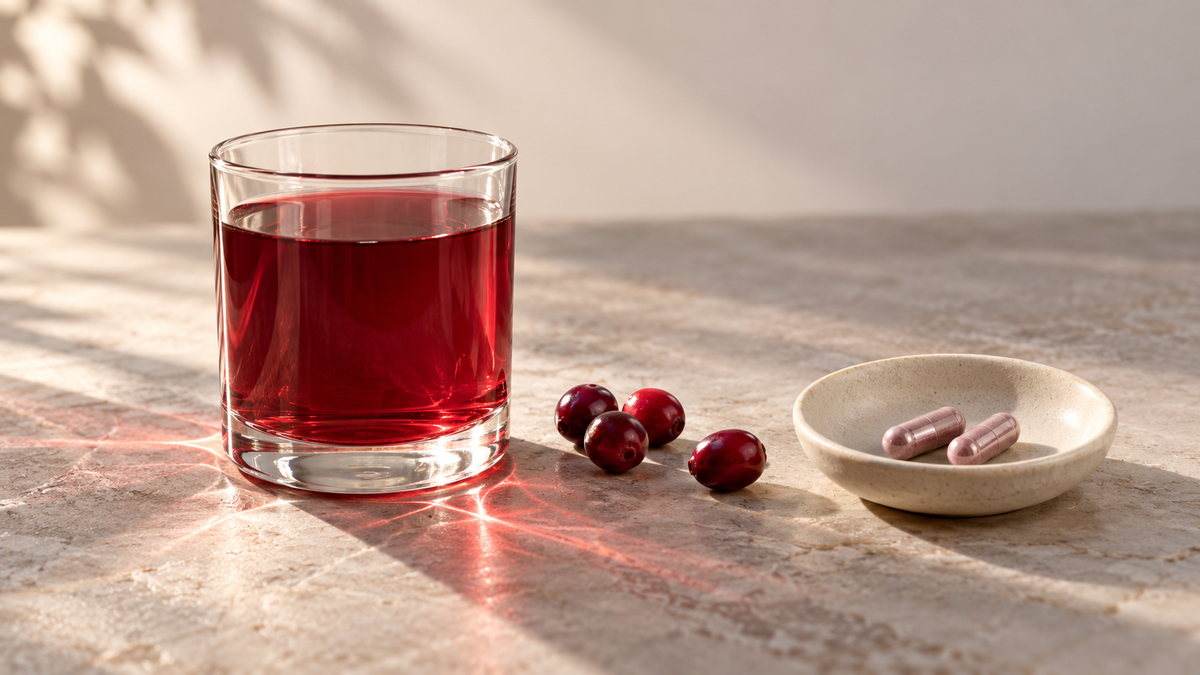
Cranberry Pills vs Cranberry Juice: Which Is Better?
In this article
For decades, the standard advice for urinary health was a glass of cranberry juice. Then cranberry pills arrived, promising the same thing without the sugar. We make a supplement with cranberry extract, so you might expect us to declare pills the winner. The research does not let us, and the honest comparison turns out to be more useful anyway.
A quick note about UTIs
A urinary tract infection is a bacterial infection that needs medical care. If you have burning, urgency, pain, fever, or blood in your urine, contact a healthcare provider. Neither juice nor pills treat an infection. The research below measured UTIs because that is how cranberry has been studied, and everything here is about everyday urinary health, not treatment.
The surprising part: juice has the better research
A 2024 network meta-analysis in European Urology Focus pooled 20 randomized trials with about 3,100 participants, comparing cranberry juice, cranberry tablets, and simply drinking more fluid. With moderate to low certainty, it supported cranberry juice: juice was associated with a 54 percent lower rate of UTIs than no treatment, a 27 percent lower rate than a placebo drink, and less antibiotic use. The authors concluded that cranberry in liquid form did better than extra fluid alone.
The broader 2023 Cochrane review, which pooled 50 trials of cranberry products of all kinds, found an overall risk reduction of about 30 percent, with the clearest benefit in women with recurrent UTIs. Juice and supplement trials both contributed to that picture.
So if you have been told juice is useless and only pills work, that is not what the evidence says. We are telling you this even though we sell a capsule.
Why juice may do well in trials
Part of the effect may be the water. Juice trials have people drinking an extra glass of fluid every day, and fluid on its own helps. In a 2018 trial, premenopausal women with recurrent UTIs who usually drank little added 1.5 liters of water a day and had about half as many episodes over a year as women who did not. That makes juice trials partly hydration trials, which is why the 2024 analysis compared juice against placebo drinks and not just against nothing.
Trial juice is not always supermarket juice. Several of the better-known trials used standardized cranberry beverages, including low-calorie versions with a measured amount of PACs, the compounds researchers track in cranberry. The cranberry juice cocktail on most store shelves is typically about a quarter real juice, sweetened, with no PAC content stated anywhere on the bottle.
The sugar math nobody mentions
This is where the comparison turns practical. A typical 8-ounce glass of cranberry juice cocktail carries about 110 calories and roughly 25 grams of sugar, most of it added. As an occasional drink, that is unremarkable. As a daily habit, which is how every trial used it, it adds up to about 9 kilograms, or 20 pounds, of sugar a year.
Pure, 100 percent cranberry juice avoids the added sugar, but it is intensely tart, which is why so much "100 percent juice" on the shelf is blended with sweeter juices like apple or grape. Low-calorie cranberry drinks solve the sugar problem with sweeteners. Capsules solve it by dropping the drink altogether.
Cranberry pills vs juice at a glance
| Cranberry juice | Cranberry pills | |
|---|---|---|
| Research support | The clearest support in a 2024 meta-analysis | Included in reviews showing benefit; less consistent |
| Typical daily amount studied | One 8-ounce glass | Varies widely by product |
| Sugar | About 25 g per glass of cocktail; less in low-calorie versions | None |
| Built-in hydration | Yes, an extra glass of fluid | No, so drink water separately |
| Consistency of dose | Rarely standardized on store shelves | Fixed amount per serving; PAC labeling varies |
| Convenience | Needs refrigeration and a daily glass | Shelf-stable and portable |
What the FDA actually allows brands to say
In 2020, following a petition from Ocean Spray, the FDA issued a letter allowing a qualified health claim for two product types: cranberry juice beverages containing at least 27 percent juice, at one 8-ounce serving a day, and cranberry supplements containing at least 500 mg of cranberry fruit powder made from whole fruit. The claim is limited to healthy women who have had a UTI, and it must say that the supporting evidence is limited and inconsistent. In other words, the FDA looked at both formats and gave them the same cautious status.
The wording is specific, and so are the products it covers. Our UroDefend contains 500 mg of a 12:1 cranberry extract rather than whole fruit powder, so the letter's terms do not describe it, and we do not use that claim.
How to choose, honestly
- Choose juice if you enjoy it, can find a low-sugar version, and like that it also gets more fluid into your day.
- Choose a capsule if you are watching sugar or calories, want the same amount every day, or know you will not drink a glass of something tart every day for months.
- Whichever you choose, drink water. The hydration evidence is strong, cheap, and works alongside either format.
- Read what a cranberry capsule actually contains. Labels range from whole fruit powder to concentrated extracts, so milligrams alone do not compare well across brands. Research and product standards often center on about 36 mg of PACs a day, measured by a lab method called DMAC.
Who cranberry does not seem to help
The Cochrane review is unusually clear about this. Cranberry products showed little or no benefit in elderly people living in care facilities, in pregnant women, and in adults with bladder-emptying problems. If you fall into one of those groups, juice versus pills is the wrong question, and a conversation with your physician is the right one. The same goes for anyone with frequent recurrences, men with urinary symptoms, anyone with a history of kidney stones, and anyone taking warfarin or another blood thinner, since interactions with cranberry have been reported.
How Vita Bloom fits
UroDefend is our answer for people who want cranberry without the daily glass of sugar: 500 mg of a 12:1 cranberry extract per serving, alongside D-mannose, pine bark extract, and vitamin C, in two capsules daily with food. No added sugar, no calories to count, and the same amount every day. It is designed to support everyday urinary tract health as part of a healthy routine, and it works best next to the water habit above, not instead of it. If you are weighing the ingredients themselves, read D-mannose and cranberry together and urinary tract health for women. The full formula is here.
Frequently asked questions
Are cranberry pills as good as cranberry juice?
Both appear in research showing benefit, but a 2024 meta-analysis found the clearest support for juice, possibly helped by the extra fluid. Pills avoid the sugar and deliver a consistent amount. The better choice is the one you will actually take every day for months, plus water either way.
How much cranberry juice should you drink a day?
Trials and the FDA's qualified claim center on one 8-ounce serving daily of a beverage with at least 27 percent cranberry juice. Check the sugar: a typical glass of cocktail has about 25 grams.
Is cranberry juice cocktail healthy?
As an occasional drink, fine. As a daily habit, it adds roughly 20 pounds of sugar a year. Low-calorie versions or capsules avoid that.
What should I look for in a cranberry supplement?
The form (whole fruit powder or extract), the amount per serving, whether a PAC figure is stated and how it was measured, and third-party testing. Our cranberry vs D-mannose guide covers how cranberry compares with the other common ingredient.
Can cranberry pills or juice treat a UTI?
No. A UTI is a bacterial infection that needs medical care. If you have symptoms, contact a healthcare provider rather than relying on cranberry in any form.
These statements have not been evaluated by the Food and Drug Administration. This product is not intended to diagnose, treat, cure, or prevent any disease.
Educational information, not personal medical advice. Ingredient research does not establish that a finished supplement treats or prevents a disease. Follow your product label and ask your healthcare professional about personal suitability.
Questions or a suggested correction? →

Leave a comment
This site is protected by hCaptcha and the hCaptcha Privacy Policy and Terms of Service apply.