
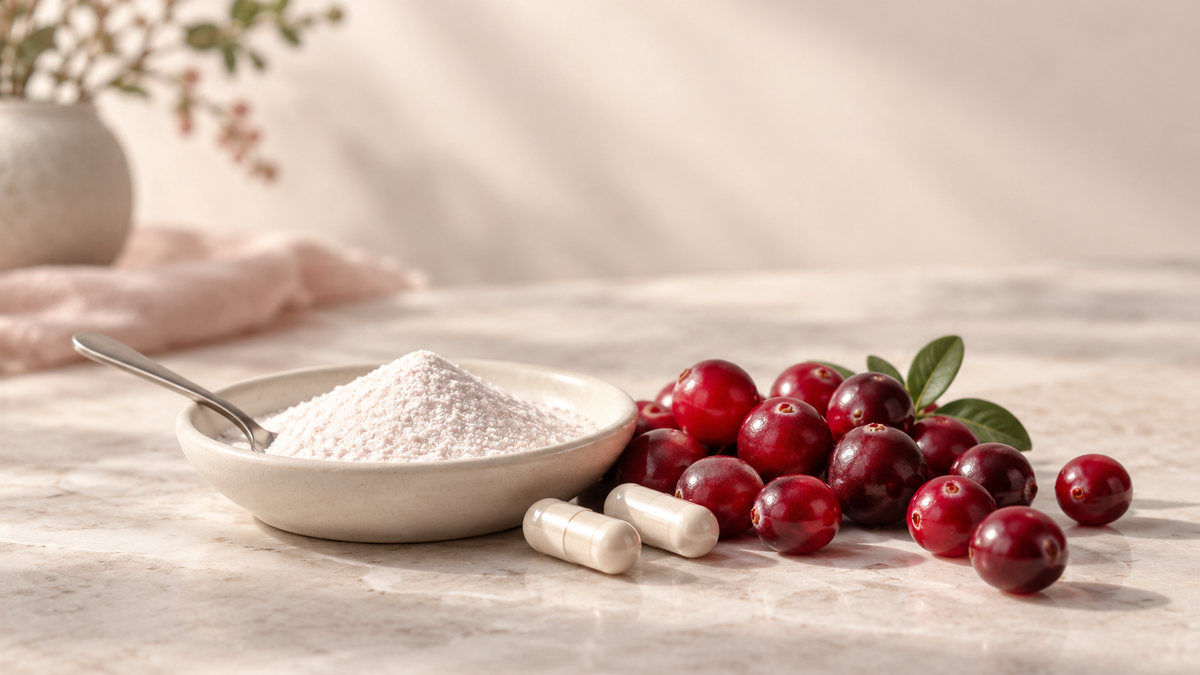
D-Mannose and Cranberry Together: Should You Take Both?
In this article
D-mannose and cranberry are the two names that come up most in urinary health, and sooner or later everyone asks the same question: can you take them together, and is there any point? We make a formula that combines them, so we have thought about this more than most. Here is the honest answer, including the parts that do not flatter the combination.
First, the boundary that matters
A urinary tract infection is a bacterial infection, and it needs medical care. If you have burning, urgency, frequency, pain, fever, or blood in your urine, contact a healthcare provider rather than reaching for a supplement. The research below studied UTIs because that is how urinary health gets measured, but no supplement treats or prevents an infection, and everything here is written with that line in mind.
The short answer
Yes, you can take D-mannose and cranberry together. There is no known interaction between them, and they are thought to work on different targets, which is the real argument for pairing them. What the combination does not have is strong human evidence of its own, and the largest trial of D-mannose by itself was disappointing. Both of those facts belong in the decision.
Two ingredients, two different targets
The interesting thing about this pairing is that it is not redundant. Both ingredients are studied for the same broad idea, making it harder for certain bacteria to stick to the lining of the urinary tract, but they are proposed to block different attachment structures.
D-mannose is a simple sugar. The bacteria most often involved in UTIs attach using hair-like structures called type 1 fimbriae, whose tips grab onto mannose on the bladder wall. Free D-mannose in the urine is thought to act as a decoy: the bacteria latch onto it instead and get flushed out. Our D-mannose guide covers this in more depth.
Cranberry contains proanthocyanidins, or PACs. A specific type of cranberry PAC is thought to interfere with a different set of attachment structures, called P fimbriae. Different lock, different key.
So the logic of combining them is coherent: two proposed mechanisms aimed at two different footholds. That is a reasonable basis for a formula. It is not, on its own, evidence that the combination works better than either ingredient alone.
What the research shows for each one
Cranberry has the stronger record. The 2023 Cochrane review, the most thorough analysis available, pooled 50 trials with nearly 9,000 participants. Cranberry products reduced the risk of symptomatic, culture-confirmed UTIs by about 30 percent overall, with the clearest benefit in women with recurrent UTIs, in children, and in people susceptible after certain medical procedures. The same review found little or no benefit in elderly people living in care facilities, in pregnant women, and in people with bladder-emptying problems. Moderate-certainty evidence, real limits, and a clear picture of who it does and does not seem to help.
D-mannose's best evidence is now its most disappointing. Earlier, smaller studies were encouraging, and pooled analyses that lean on them still look favorable. But in 2024, the largest placebo-controlled trial to date, run across 99 UK primary care practices in 598 women with recurrent UTIs, found that 2 grams of D-mannose daily for six months did not meaningfully reduce medically attended UTIs compared with placebo: 51 percent versus 56 percent, a difference that was not statistically significant. The authors concluded that D-mannose should not be recommended for that purpose in that group. We think any honest article about D-mannose has to lead with that trial, not bury it.
The combination has the thinnest evidence of all. A 2022 systematic review found only a small number of studies testing cranberry and D-mannose together, rated the support as low-level, and called for larger, properly blinded trials. Nobody has yet shown in a large, well-controlled trial that taking both beats taking cranberry alone.
So why combine them at all?
Because the two ingredients do different jobs, both are low-risk for most healthy adults, and the better-studied of the two, cranberry, is doing the heavier lifting either way. A combination is a formulation choice built on mechanism plus the cranberry evidence, not a result proven in its own trial. That is how we think about our own formula, and it is how we would want any brand to describe theirs.
How to take them together
- Same time is fine. There is no known reason to separate them. With food is a sensible default for anything you take daily, and it is what our label directs.
- Think in months, not days. The research on both ingredients measured outcomes over months of daily use. Neither is a same-day fix, and neither replaces care when symptoms appear.
- Drink water. This is the unglamorous habit with some of the best evidence. In a 2018 trial, premenopausal women with recurrent UTIs who usually drank little fluid added 1.5 liters of water a day and had about half as many episodes over a year as the women who did not. It costs nothing and pairs with everything.
- One formula, not a pile. If you already take a cranberry product and want to add D-mannose, check the totals on both labels rather than stacking several urinary formulas on top of each other.
Who should check with a physician first
- Anyone with diabetes or managing blood sugar, since D-mannose is a sugar.
- Anyone taking warfarin or another blood thinner, since interactions with cranberry have been reported.
- Anyone with a history of kidney stones, since cranberry products contain oxalate.
- Pregnant or nursing women, particularly since the Cochrane review found little benefit from cranberry in pregnancy.
- Men with urinary symptoms. A UTI in a man is treated as a more complicated situation that usually needs a medical workup, and urinary symptoms in men often have causes no supplement addresses.
- Anyone with frequent recurrences. Recurrent UTIs deserve a physician's evaluation and a real prevention plan, which may include options with far stronger evidence than any supplement.
How Vita Bloom fits
Our UroDefend combines cranberry extract (12:1, 500 mg), D-mannose (300 mg), pine bark extract (100 mg), and vitamin C (100 mg) in two capsules daily with food. It follows the logic of this article: cranberry as the better-studied anchor, D-mannose for its distinct proposed mechanism, and pine bark as a second botanical source of PACs, which we explain in our pine bark guide. It is designed to support everyday urinary tract health as part of a healthy routine, alongside water and good habits. It is not a treatment for an infection or a replacement for medical care. You can see the full formula here, and if you are weighing cranberry formats, read cranberry pills vs cranberry juice.
Frequently asked questions
Can you take D-mannose and cranberry together?
Yes. There is no known interaction between them, and they are thought to target different bacterial attachment structures. Check with your physician first if you have diabetes, take a blood thinner, have a history of kidney stones, or are pregnant.
Is D-mannose or cranberry better?
On current evidence, cranberry has the larger and stronger research base. D-mannose's largest placebo-controlled trial, published in 2024, did not find a meaningful benefit. Our cranberry vs D-mannose comparison goes deeper.
Does the combination work better than either one alone?
That has not been shown in a large, well-controlled trial. The rationale is mechanistic: two ingredients aimed at two different targets. A 2022 systematic review rated the evidence for combinations as low-level.
When should I take D-mannose and cranberry?
At the same time is fine, and with food is a sensible default. Taking them consistently over months matters far more than the hour you choose.
Can D-mannose and cranberry treat a UTI?
No. A UTI is a bacterial infection that needs medical care, and no supplement treats one. If you have symptoms, contact a healthcare provider.
These statements have not been evaluated by the Food and Drug Administration. This product is not intended to diagnose, treat, cure, or prevent any disease.
Educational information, not personal medical advice. Ingredient research does not establish that a finished supplement treats or prevents a disease. Follow your product label and ask your healthcare professional about personal suitability.
Questions or a suggested correction? →

Leave a comment
This site is protected by hCaptcha and the hCaptcha Privacy Policy and Terms of Service apply.