PeptiStrong Dosage, Side Effects, and Safety: An Honest Guide
PeptiStrong is new enough that most of what is written about its dosing and safety is either copied from the manufacturer or guessed. As physicians who chose to sell it, we would rather give you the version built from the actual trials, including the one safety question that is specific to fava beans and that almost no supplement brand mentions.
The dose: 2.4 grams a day, and why
The two human trials that used the supplement form of PeptiStrong both used 2.4 g per day, and that is the amount the FDA reviewed for use in foods. It is the only dose with human outcome data, so it is the dose to take. More is not better studied; it is simply unstudied.
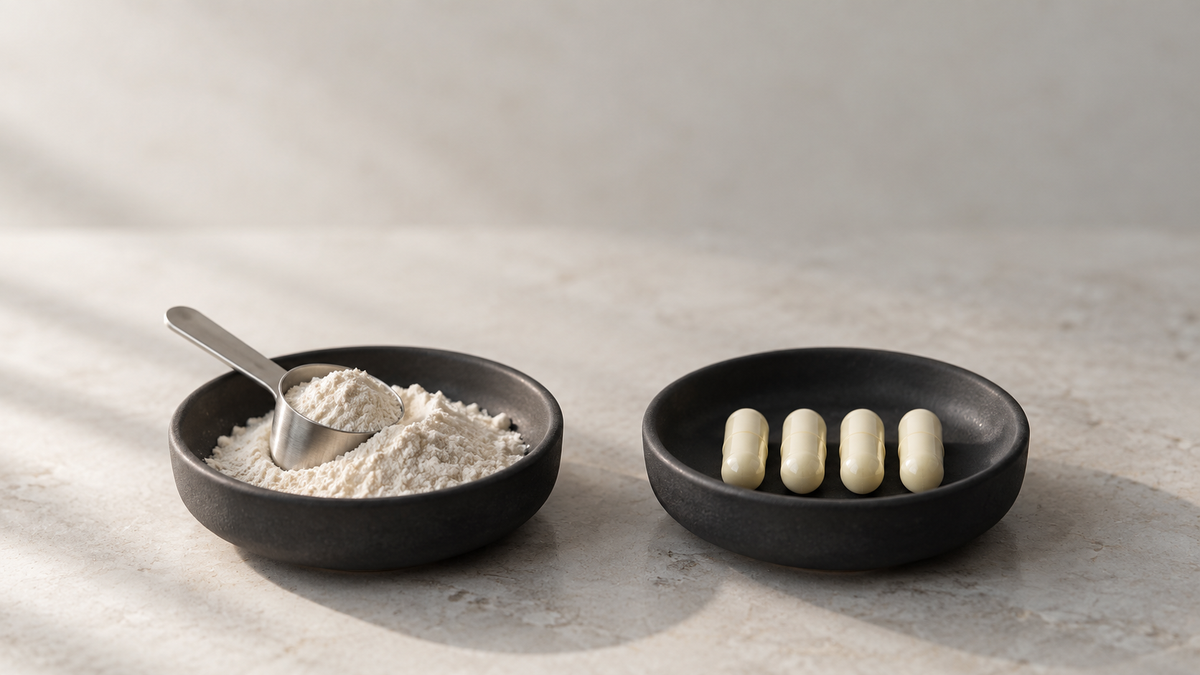
In the trials, 2.4 g was delivered as five capsules of 480 mg. Ours delivers the same 2.4 g in four capsules of 600 mg. Same daily amount, one fewer capsule.
One thing to be clear about: 2.4 g is tiny compared with the protein you eat. PeptiStrong is not a protein source and does not change how much protein you need. It is taken in addition to a normal diet, as a signaling ingredient. If that distinction is new to you, start with what PeptiStrong is.
When to take it
Honest answer: timing has not been studied. In the trials, participants took the full daily dose at once, every day, whether or not they trained that day. So the evidence-based instruction is simply daily and consistent. Our label says four capsules daily with water, at any time. Many people take them around a workout on training days, which is reasonable and unproven; taking them with breakfast on every day is equally reasonable and closer to what the trials did. Pick the moment you will not forget. Our timing guide makes the general case for consistency over cleverness.
With or without food does not appear to matter based on anything published. There is no loading phase and no need to cycle it.
How long before judging it
Eight weeks, with resistance training. That is the length of the longest trial, in which strength differences showed up by week four and endurance and bone measures by week eight. The recovery trial ran about two weeks before its exercise test. Nothing about this ingredient works overnight, and nothing in the research suggests it does anything for people who are not training. Judge it with a training log against your baseline, not against how you feel on day ten.
Side effects: what the trials reported
Across the three published trials, which together enrolled around 130 adults for up to eight weeks, no notable adverse effects attributable to PeptiStrong were reported. That is reassuring and it is also the limit of what we know: the trials were small and short, and none of them was designed as a safety study.
What is realistic to expect, based on the ingredient being a plant protein hydrolysate taken as four capsules:
- Mild digestive effects in some people, particularly if four capsules on an empty stomach does not sit well. Taking them with a meal usually resolves this.
- Nothing you can feel. This is the most common experience. PeptiStrong is not a stimulant, and its effects in trials were measured, not felt.
The fava bean question: G6PD deficiency
This is the section we would want to read if we were the customer. Fava beans contain two natural compounds, vicine and convicine, that can trigger a serious breakdown of red blood cells in people with G6PD deficiency, an inherited enzyme condition. The reaction is called favism, and it is why people with G6PD deficiency are told to avoid fava beans entirely. G6PD deficiency is common worldwide, especially in people of Mediterranean, Middle Eastern, African, and South or Southeast Asian ancestry, and many people who have it do not know.
PeptiStrong is a processed protein fraction, not the whole bean, and according to the manufacturer's analytical data the amounts of vicine and convicine that may remain are modeled to fall below the levels reported to trigger favism. We have no reason to doubt that data, and it is also the manufacturer's data. So our position, as physicians, is the cautious one: if you have G6PD deficiency, or a personal or family history of favism, do not take PeptiStrong without talking to your physician first. If you have never been tested and belong to a higher-prevalence group, that conversation is worth having anyway.
The same caution applies in the ordinary way to legume allergies. PeptiStrong is derived from a legume, and anyone with a fava bean, peanut, soy, or other legume allergy should treat it accordingly.
Who should check with a physician first
- Anyone with G6PD deficiency or a history of favism, as above
- Anyone with a legume allergy
- Pregnant or nursing women, and anyone under 18, since none of the trials included them
- Anyone with a kidney condition or on a medically restricted protein intake, out of general caution with any protein-derived product
- Anyone on prescription medication. No interactions have been identified, and the ingredient is food-derived, but a new ingredient with three trials has not been studied alongside medications, so the usual pharmacist check applies.
Regulatory status, stated precisely
Nuritas, the manufacturer, self-affirmed GRAS status for PeptiStrong in 2022. In December 2024, the FDA issued a letter of no objection to its GRAS notice, covering food and beverage uses at 2.4 g per serving. We describe that exactly, the way we do for every branded ingredient we sell: an FDA review of safety data for food uses at the same serving used in supplements, which is meaningful, and not an FDA approval of a supplement or of any health claim, which does not exist for any dietary supplement.
How Vita Bloom fits
Our PeptiStrong Muscle Peptides deliver the full 2.4 g studied serving in four capsules, as the only active ingredient, made in an NSF-certified, GMP-compliant facility and third-party tested. The product is here, and if you are deciding between this and the basics, read PeptiStrong vs creatine first.
Frequently asked questions
How much PeptiStrong should I take?
2.4 g per day, the dose used in both supplement-form human trials and reviewed by the FDA for food use. That is four of our capsules, taken all at once, daily.
When is the best time to take PeptiStrong?
Timing has not been studied. Trial participants took it once daily, every day. Take the full dose at whatever consistent moment you will remember, with or without food, on training and rest days alike.
What are the side effects of PeptiStrong?
The three published trials reported no notable adverse effects. Mild digestive discomfort is possible with any protein-derived capsule and usually resolves by taking it with a meal. The important cautions are G6PD deficiency and legume allergy.
Can people with G6PD deficiency take PeptiStrong?
Not without a physician's guidance. PeptiStrong comes from fava beans, and although the manufacturer reports that residual vicine and convicine fall below favism-triggering levels, we recommend that anyone with G6PD deficiency or a history of favism talk to their physician before using any fava-derived product.
Is PeptiStrong FDA approved?
No dietary supplement is FDA approved. What exists is an FDA letter of no objection to PeptiStrong's GRAS notice for food and beverage uses at 2.4 g per serving, issued in December 2024, following the manufacturer's self-affirmed GRAS determination in 2022.
PeptiStrong® is a registered trademark of Nuritas Ltd. Vita Bloom Labs uses the branded ingredient and is not otherwise affiliated with Nuritas.
These statements have not been evaluated by the Food and Drug Administration. This product is not intended to diagnose, treat, cure, or prevent any disease.

Leave a comment
This site is protected by hCaptcha and the hCaptcha Privacy Policy and Terms of Service apply.