
D-Mannose: How It Works, Dosage, and Safety
In this article
D-mannose shows up in almost every conversation about urinary health, often alongside cranberry. It has an appealing, easy-to-understand mechanism, and it has become one of the most popular ingredients in the category. Here is a clear look at what D-mannose is, how it is thought to work, what the research actually shows, and how it is dosed. First, an important note.
A quick and important note about UTIs
A urinary tract infection is a bacterial infection. If you think you have a UTI, with symptoms like burning, urgency, frequency, or blood in your urine, contact a healthcare provider rather than reaching for a supplement. Untreated infections can become serious. D-mannose is studied as an ingredient for supporting everyday urinary tract health, not as a way to treat or prevent an infection. Everything below is written with that boundary in mind.
What is D-mannose?
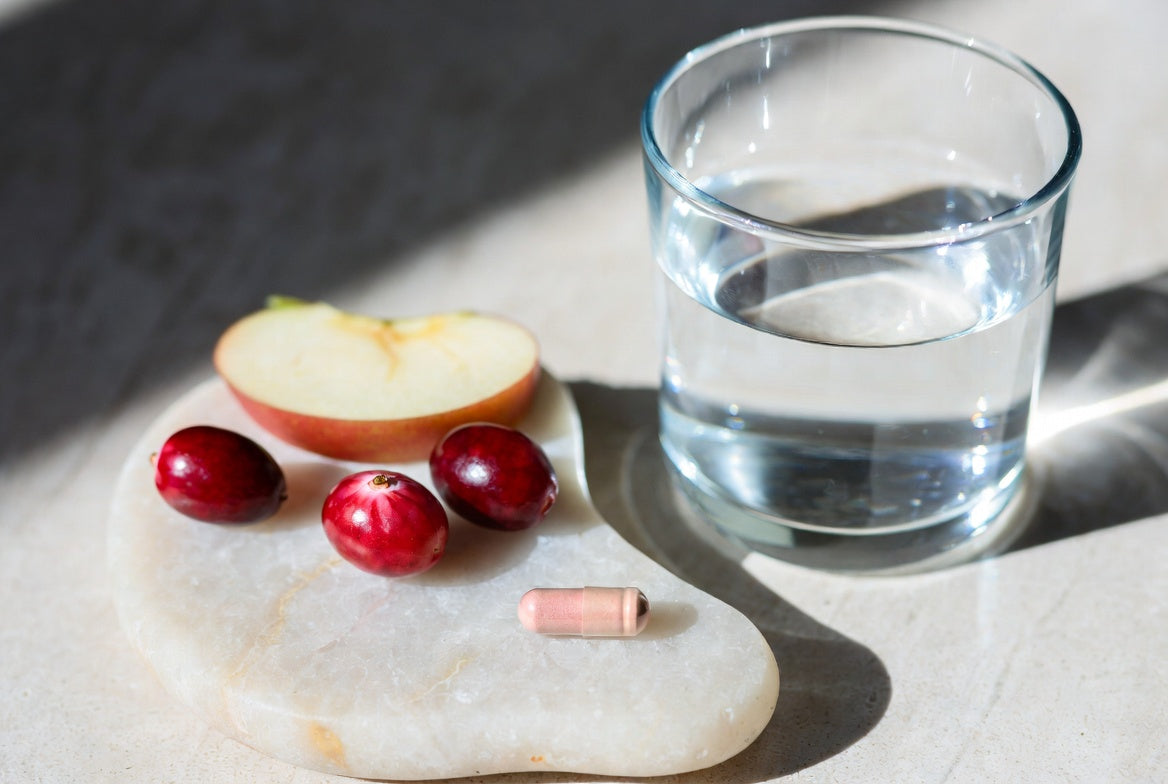
D-mannose is a simple sugar, a monosaccharide, that occurs naturally in fruits like cranberries, apples, and peaches. It is closely related to glucose, but your body handles it very differently. Rather than being used much for energy, a large share of the D-mannose you take is filtered by the kidneys and passes into the urine, which is exactly why it is studied in the context of the urinary tract.
How D-mannose is thought to work
The proposed mechanism is elegant and specific. Most UTIs are caused by E. coli, and these bacteria attach to the urinary tract lining using tiny hair-like structures called type 1 fimbriae, tipped with a protein called FimH. That FimH protein happens to bind strongly to mannose.
The idea is that when D-mannose is present in the urine, E. coli latch onto the free mannose instead of the bladder wall, so the bacteria are more likely to be flushed out with normal urination rather than sticking around. It is an anti-adhesion concept, similar in spirit to how cranberry proanthocyanidins are thought to work, though through a different pathway.
What the research actually shows
This is where honesty matters more than enthusiasm. The mechanism is appealing, and some earlier, smaller studies were encouraging. But the strongest recent evidence is more sobering. A large 2024 trial published in JAMA Internal Medicine, which followed hundreds of women with recurrent UTIs in primary care, found that D-mannose did not significantly reduce UTI recurrence compared with placebo.
That is why we describe the evidence for D-mannose as mixed rather than settled. This research is about the ingredient studied on its own; it is not a claim that any supplement prevents or treats infections. A physician-owned brand would rather tell you that plainly than oversell a single mechanism.
D-mannose dosage
Study doses have varied quite a bit, and there is no single official amount. Research has often used amounts in the range of around 2 grams per day, sometimes split into smaller servings, but products differ widely. The practical guidance is simple: follow the dose on your product label rather than a number from an article, and give any urinary health supplement a consistent daily trial rather than expecting an overnight effect.
D-mannose vs cranberry
These two are the pillars of the urinary health category, and they work through related but distinct anti-adhesion ideas. Cranberry, standardized for its proanthocyanidin content, has the more developed body of research, while D-mannose is mechanistically appealing with more mixed clinical results. Because they are thought to act through different pathways, many formulas include both. We compare them directly in our guide to cranberry vs D-mannose.
Safety
D-mannose is generally well tolerated by healthy adults at typical doses. A few sensible notes:
- It is a sugar, and although it is largely not used for energy the way glucose is, anyone actively managing their blood sugar should check with their physician first.
- Larger doses can cause loose stools or digestive upset in some people.
- If you are pregnant, nursing, or take medication, talk to your physician before starting.
How Vita Bloom fits
Our UroDefend pairs D-mannose with standardized cranberry extract, pine bark extract, and vitamin C in a single once-daily formula, so it combines several ingredients traditionally used to support everyday urinary tract health in one once-daily serving, rather than a single ingredient. It is designed to support everyday urinary tract health, not to replace medical care for an infection.
UroDefend is our daily urinary wellness formula. It is not a treatment for a UTI.*
When to see a doctor
Contact a healthcare provider if you have UTI symptoms, if they are getting worse, if you have fever, back or flank pain, nausea, or blood in your urine, or if you get frequent recurrent infections. Recurrent UTIs in particular deserve a proper medical workup rather than a supplement-only approach.
Frequently asked questions
What is D-mannose?
D-mannose is a simple sugar found naturally in fruits like cranberries and apples. Because much of it passes into the urine rather than being used for energy, it is studied in the context of urinary tract health.
How does D-mannose work?
The leading idea is that D-mannose in the urine binds the FimH protein on E. coli, so the bacteria attach to the mannose instead of the bladder wall and are more easily flushed out. It is an anti-adhesion mechanism.
How much D-mannose should I take?
Study doses have often been around 2 grams per day, but products vary, so follow the dose on your label. Give it a consistent daily trial rather than expecting an immediate result.
Does D-mannose actually work?
The mechanism is appealing and some early studies were encouraging, but a large 2024 trial found it did not significantly outperform placebo for recurrent UTIs. The honest summary is that the evidence is mixed. That is why we favor formulas that combine well-studied urinary-health ingredients rather than leaning on any single one.
Is D-mannose safe to take daily?
It is generally well tolerated by healthy adults at typical doses. Because it is a sugar, anyone managing blood sugar should check with a physician first, and larger doses can cause loose stools in some people.
These statements have not been evaluated by the Food and Drug Administration. This product is not intended to diagnose, treat, cure, or prevent any disease.
Educational information, not personal medical advice. Ingredient research does not establish that a finished supplement treats or prevents a disease. Follow your product label and ask your healthcare professional about personal suitability.
Questions or a suggested correction? →


Leave a comment
This site is protected by hCaptcha and the hCaptcha Privacy Policy and Terms of Service apply.