
Article: L-Theanine in Green Tea: How Much Is in a Cup and in Matcha?
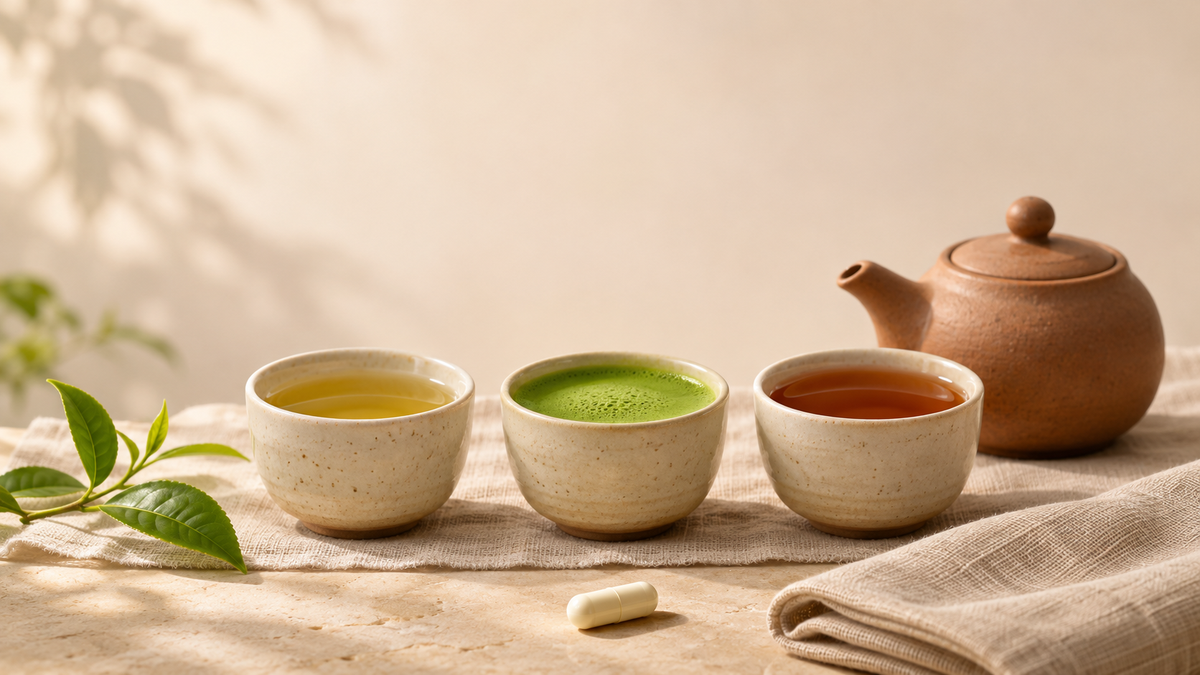
L-Theanine in Green Tea: How Much Is in a Cup and in Matcha?
In this article
The amount of L-theanine in green tea is usually about 8 to 25 mg per 200 mL cup, according to a 2026 review, and a 2025 laboratory study of commercial green teas measured 12 to 17 mg per 200 mL. That is a fraction of the roughly 100 to 400 mg doses that the same review links to effects in human trials, and every cup also brings caffeine, so the balance between the two depends on the tea and how you brew it.
L-theanine is an amino acid found in the tea plant and some mushrooms, where it makes up roughly 1 to 2% of the dry tea leaf. Coffee contains none.
How much L-theanine is in green tea and other teas
A 2025 laboratory study in Turkey bought commercial teas, brewed 2 g of leaf in 200 mL of water at 80 or 100 °C for 2, 5 or 10 minutes, and measured caffeine in 68 products and L-theanine in 20 of them. The ranges below span those brewing conditions. USDA figures come from the US Department of Agriculture food database.
| Tea | L-theanine per cup (range) | Caffeine per cup (range) | Source note |
|---|---|---|---|
| Green tea | About 8 to 25 mg per 200 mL (typical cup, 2026 review); 12 to 17 mg per 200 mL measured in 2025 | About 11 to 27 mg per 200 mL (2025); about 29 mg per 1 cup, 245 g (USDA) | 2026 review figure covers commercial green or black tea. 2025 lab study of commercial green teas. |
| Black tea | About 12 to 23 mg per 200 mL | About 14 to 27 mg per 200 mL | 2025 lab study, short brews. USDA: about 47 mg caffeine per 8 oz (237 g) cup. |
| White tea | About 2 to 4 mg per 200 mL | About 6 to 31 mg per 200 mL | 2025 lab study. A 2016 survey found white close to green per gram. |
| Oolong tea | About 2 to 4 mg per 200 mL | About 4 to 29 mg per 200 mL | 2025 lab study. Oolong ranged from 0.9 to 12.4 mg per gram of leaf in the 2016 survey. |
| Matcha, 2 to 3 g whisked | About 20 to 50 mg | About 32 to 100 mg | Calculated from a 2022 analysis (about 10 mg L-theanine, 16 mg caffeine per gram) and the matcha from a 2017 study, as reported in a 2018 paper (67 mg and 136 mg in 4 g). |
| Caffeine 2.0 + L-Theanine, 1 capsule | 50 mg | 22.5 mg Deura9® d9-caffeine | Fixed per capsule. |
In a 2016 Hungarian survey of commercial teas steeped for 3 minutes at 80 °C, the average L-theanine released per gram of leaf was 6.6 mg for green, 6.3 mg for white, 6.1 mg for oolong and 5.1 mg for black tea, with large differences within each type. Caffeine usually matches or exceeds L-theanine, and it varies too: a 2008 US study of 20 commercial teas found 14 to 61 mg of caffeine per 6 or 8 oz serving of white, green or black tea, and steeping time changed the result.
How much L-theanine is in matcha?
With matcha you drink the whole powdered leaf rather than an infusion. A 2022 Czech laboratory analysis measured about 10 mg of L-theanine and 16 mg of caffeine per gram of matcha. A traditional serving in Japan uses about 2 to 3 g, which works out to roughly 20 to 30 mg of L-theanine and 32 to 48 mg of caffeine.
Grade matters a great deal. A 2018 Japanese study measured 76 matcha products sold in Japan and 67 sold elsewhere. Fifty of the Japanese products held more than 17 mg of L-theanine per gram, compared with only 6 of those sold outside Japan, and the authors noted that low-grade green tea powders are also sold as matcha. The same paper reported that the 4 g serving used in a 2017 Dutch study of 23 adults held 67 mg of L-theanine and 136 mg of caffeine.
So a bowl of high-grade matcha can approach the 50 mg of L-theanine in one capsule of Caffeine 2.0 + L-Theanine, but it usually brings more milligrams of caffeine with it. Our comparison of matcha, coffee and d9-caffeine with L-theanine goes further.
Does black tea have L-theanine?
Yes. Black tea comes from the same plant and keeps much of its L-theanine. In the 2016 survey, it released slightly less per gram than green tea on average. In the 2025 study, black and green teas had the highest amounts per cup.
The clearest exception is pu-erh, a long-fermented tea. The 2016 survey detected none, and the 2025 study measured only about 3 to 5 mg per 200 mL.
What changes the amount of L-theanine in tea
- Leaf age and grade. A 2024 Japanese lab study noted that L-theanine falls as tea leaves mature. A coarse tea made from hard shoots and old leaves had far less, and released it less efficiently.
- Shade growing. Matcha and some premium green teas come from plants shaded for about two to three weeks before harvest, which slows the conversion of L-theanine into catechins. The shaded teas in the 2024 study held 18 to 32 mg per gram of leaf, and a 2022 Chinese study found that 85% and 95% shade raised both L-theanine and caffeine.
- Steeping time. Longer steeping pulls out more of both. In the 2025 study, L-theanine in green, white and black tea rose between 2 and 5 minutes, with no significant gain after that. In the 2016 study, steeping one green tea for 90 minutes instead of 3 yielded about twice the L-theanine and 1.5 times the caffeine.
- Water temperature. In the 2025 study, brewing at 100 °C instead of 80 °C did not significantly change L-theanine, while caffeine tended to rise with heat. In the 2024 study, a 15 hour cold steep at 4 °C still drew out amino acids such as L-theanine well, while caffeine came out at only about 44% of what an 80 °C brew would predict.
- Bags or loose leaf. In the 2025 study, L-theanine did not differ significantly between bagged and loose green or black tea. Caffeine did for black tea: cup-sized bags released about 39 mg per 200 mL after 10 minutes at 100 °C, versus 24 mg from loose leaf, possibly because smaller leaf pieces extract faster.
How many cups of green tea equal 200 mg of L-theanine?
Using the 2026 review figure of 8 to 25 mg per 200 mL cup, you would need roughly 8 to 25 cups of green or black tea to reach 200 mg. With the 2025 green tea figures of 12 to 17 mg per 200 mL, 200 mg takes about 12 to 17 cups, which would also carry somewhere around 130 to 460 mg of caffeine.
For matcha at 10 mg per gram, 200 mg would take about 20 g of powder, roughly seven to ten servings, with about 320 mg of caffeine.
The L-theanine itself appears to be absorbed the same way from either source. In a 2012 German crossover study, 12 healthy adults took 100 mg of L-theanine once as capsules and once as green tea, and blood levels peaked about 48 minutes after both, at similar levels.
Green tea vs L-theanine supplement: dose and ratio
In the 2026 review, reported effects in human trials mostly came at about 100 to 400 mg of L-theanine. For the full evidence, see L-theanine benefits.
- 2008, 27 adults: one dose of 100 mg of L-theanine with 50 mg of caffeine improved speed and accuracy on an attention-switching task at 60 minutes and reduced distraction on a memory task at 60 and 90 minutes, compared with placebo.
- 2010, 44 young adults: one dose of 97 mg with 40 mg of caffeine improved task-switching accuracy and self-rated alertness, and lowered self-rated tiredness, but did not change other tasks such as visual search.
- 2019, 30 adults: 200 mg a day for four weeks improved three sleep questionnaire subscale scores, such as time to fall asleep, more than placebo.
All three were small. The first two were run by industry researchers, and two authors of the third worked for the L-theanine supplier.
The ratio differs too. Those two focus studies used about 2 to 2.4 parts L-theanine to 1 part caffeine, and a 2026 review by an industry research team noted that trials reporting added benefit from the pair used at least 100 mg of L-theanine at ratios between 1 to 1 and 2 to 1. Tea usually runs the other way. In the 2016 survey, the average caffeine to L-theanine ratios by tea type ran from about 2.8 to 4.2, or roughly a quarter to a third of a part L-theanine per part caffeine, and the matcha figures above come to about 0.5 to 0.6. Each capsule of Caffeine 2.0 + L-Theanine has 50 mg of L-theanine with 22.5 mg of d9-caffeine, about 2.2 to 1 by weight. Because d9-caffeine is more potent per milligram than ordinary caffeine, that is a comparison by weight only.
Tea offers flavor, ritual and other compounds such as catechins; a supplement offers a known dose. If you are new to L-theanine, our guide to how much L-theanine to take covers starting doses, and our article on when to take L-theanine covers timing.
Who should check with a physician first
Talk to your physician before using L-theanine supplements or caffeine products if you are pregnant or breastfeeding, under 18, sensitive to caffeine, or have a heart condition, high blood pressure, an arrhythmia, an anxiety disorder or a sleep disorder. Also check first if you take prescription medication, especially blood pressure medication, sedatives or stimulant medication. Caffeine 2.0 + L-Theanine is not for children, pregnant or breastfeeding individuals, or people sensitive to caffeine.
How Vita Bloom fits
| Product | Vita Bloom Labs Caffeine 2.0 + L-Theanine Supplement (d9-Caffeine) |
|---|---|
| Per serving | 22.5 mg Deura9® d9-caffeine + 50 mg L-theanine |
| Serving and form | 1 capsule, vegetarian cellulose, unflavored; 30 capsules, 30 servings |
| How to take | Take 1 to 4 capsules per day as needed, with or without food. Do not exceed 90mg of d9-caffeine per day. |
Caffeine 2.0 + L-Theanine, the Vita Bloom Labs caffeine and L-theanine supplement, pairs 22.5 mg of Deura9® d9-caffeine with 50 mg of L-theanine in each capsule for calm, focused energy. That is about the L-theanine of two to six 200 mL cups of tea, in a fixed dose and ratio. It is a daytime product: take 1 to 4 capsules per day as needed, start with one capsule to gauge your response, do not exceed 90 mg of d9-caffeine (4 capsules) per day, and avoid late-day doses. For how L-theanine works in the body, see what L-theanine does.
Frequently asked questions
Does green tea or black tea have more L-theanine?
It depends on the tea. One survey found slightly more per gram in green tea, while a 2025 study found the two similar per cup, with black tea reaching somewhat higher amounts in some brews.
Does cold brewing change the L-theanine in green tea?
In a 2024 lab study, a 15 hour cold brew still drew out L-theanine well while releasing much less caffeine, so a cold brew tips the balance toward L-theanine. The total still depends on how much leaf you use and how long it steeps.
Can I drink green tea with Caffeine 2.0 + L-Theanine?
Yes. Follow the label: start with one capsule, do not exceed 90 mg of d9-caffeine (4 capsules) per day, and avoid late-day doses. Count it as caffeine when tracking daily stimulant intake.
Deura9® is a registered trademark of Lennham Pharmaceuticals, Inc. under exclusive license to d9 Designs Inc.
These statements have not been evaluated by the Food and Drug Administration. This product is not intended to diagnose, treat, cure, or prevent any disease.
Educational information, not personal medical advice. Ingredient research does not establish that a finished supplement treats or prevents a disease. Follow your product label and ask your healthcare professional about personal suitability.
Questions or a suggested correction? →

Leave a comment
This site is protected by hCaptcha and the hCaptcha Privacy Policy and Terms of Service apply.