
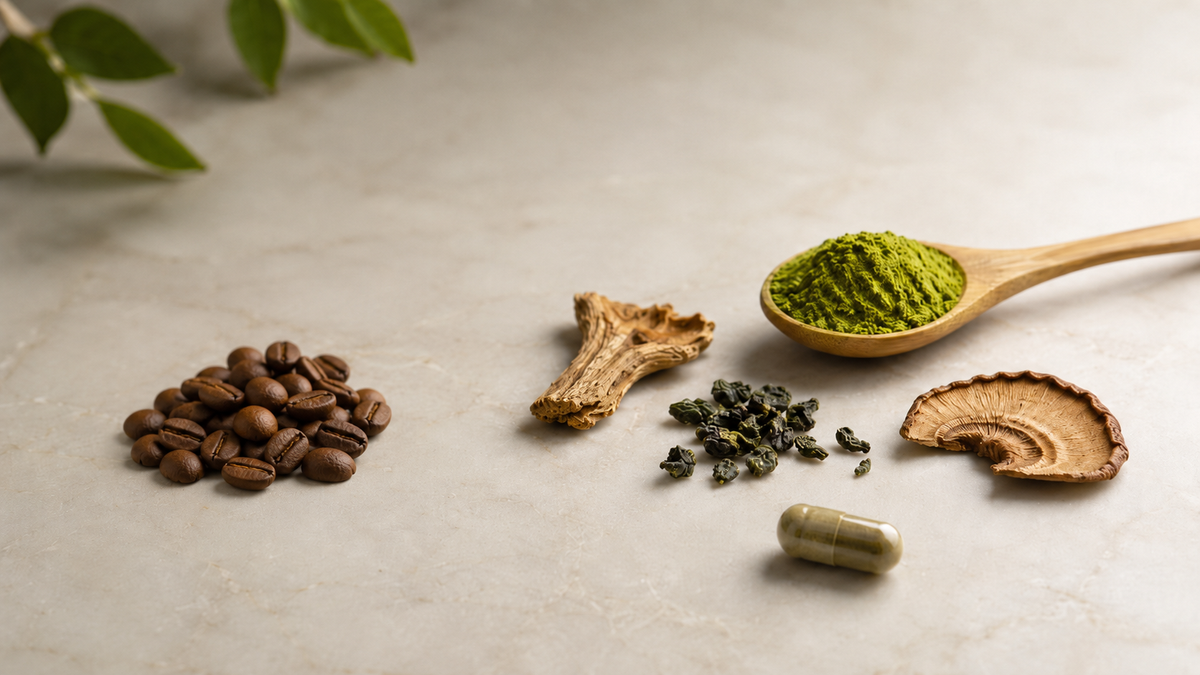
Caffeine Alternatives for Focus Without the Jitters
In this article
Most people who go looking for a caffeine alternative are not trying to quit coffee because they dislike it. They are trying to keep the focus without the jitters, the racing heart, the 3 p.m. crash, or the 2 a.m. staring at the ceiling. That is a reasonable thing to want, and the options are better than they used to be.
Here is an honest look at the main caffeine alternatives, including which ones have stronger evidence behind them, which are thinner than the marketing suggests, and what to expect from each.
First, why caffeine does that to you
Caffeine works largely by blocking adenosine, the molecule that builds up during the day and makes you feel sleepy. Block it, and you feel alert. But caffeine is also a broad stimulant that can increase cardiovascular activation, which is where jitters and that wired feeling come from for sensitive people.
Then there is timing. Caffeine's half-life averages around four hours but varies enormously between individuals, anywhere from roughly 2.5 to nearly 10 hours. If you are a slow metabolizer, an afternoon coffee really can still be working at bedtime. That variation is why one person can drink espresso after dinner and sleep fine while another is wrecked by a morning cup.
The main caffeine alternatives, honestly assessed
L-theanine
An amino acid found in tea, studied for promoting a calm, focused state. Important nuance: it is not a stimulant on its own. Most of the research pairs it with caffeine, where it appears to smooth out the edge. If you want to keep some caffeine but soften it, this is the classic pairing. If you want to replace caffeine entirely, theanine by itself will not give you alertness.
Matcha and green tea
Often marketed as a gentler option, and subjectively many people agree. But be clear about what it is: matcha still contains caffeine. It comes alongside L-theanine, which is the most likely reason it can feel smoother, though the caffeine in it still behaves like caffeine. If caffeine itself is your problem, a typical serving is usually a smaller dose of caffeine rather than an alternative to it, and a strong or second serving closes that gap.
Rhodiola rosea
An adaptogenic herb traditionally used and studied for fatigue and stress resilience, particularly under demanding conditions. The research is genuinely interesting but mixed, and it does not act like a stimulant. Think of it as supporting resilience rather than producing alertness on demand.
Ginseng
Long traditional use for energy and fatigue, with a body of research that is suggestive but not decisive. Like rhodiola, it is a slower, subtler category than a stimulant.
B vitamins
Here is the honest version, which supplement marketing rarely gives you: B vitamins are required for normal energy metabolism, so if your intake is genuinely low, bringing it back into range can make a noticeable difference. If you are not low, taking more is unlikely to make you feel energized. Useful for a genuine gap, not a substitute for caffeine.
Cordyceps and mushroom coffee
Popular, pleasant, and usually low in caffeine or caffeine-free. The human evidence for energy and performance benefits is limited. If you enjoy the ritual and want less caffeine, it is a fine swap. Just do not expect it to do what coffee does.
Paraxanthine
This one works differently from the rest of the list, because it is not a substitute for caffeine so much as the compound caffeine becomes in your body. Paraxanthine is the primary metabolite of caffeine, and researchers believe it accounts for much of the alertness people attribute to coffee.
Taking it directly skips the conversion step. In a small human study it showed a half-life of roughly 3.1 hours compared with about 4.1 hours for caffeine, and it is associated with less of the adrenaline-style activation behind jitters. That combination, alertness with a shorter tail, is exactly what most people searching for a caffeine alternative are actually after.
At a glance
| Option | Contains caffeine? | What to expect |
|---|---|---|
| L-theanine | No | Smooths caffeine when paired with it; not alerting alone |
| Matcha | Yes | A gentler-feeling caffeine, not a replacement for it |
| Rhodiola | No | Studied for fatigue and stress resilience; subtle, not stimulating |
| Ginseng | No | Long traditional use; research suggestive but not decisive |
| B vitamins | No | Helpful mainly if you are low in one |
| Cordyceps | Usually no | Pleasant ritual swap; limited human evidence |
| Paraxanthine | No, it is caffeine's metabolite | Studied for alertness and focus; shorter half-life and less reported jittery activation than caffeine |
The unglamorous things that actually work
No supplement outperforms the basics, and a physician-owned brand should say so plainly:
- Sleep. Nothing on this list competes with an extra hour.
- Morning light. Getting outside early helps set your circadian rhythm.
- Hydration. Mild dehydration can feel a lot like fatigue.
- Movement. A short walk is often enough on its own, before you reach for a second coffee.
- What you eat. A breakfast built on protein and fiber tends to blunt the spike and slump pattern.
Supplements support a good routine. They do not rescue a bad one.
How to taper caffeine comfortably
If you are switching away from a real caffeine habit, taper rather than quitting cold. Abrupt withdrawal commonly causes headaches, irritability, and fatigue for a few days. Reducing gradually over a week or two, and moving your last caffeine earlier in the day, makes the transition far easier. The taper itself is what makes the difference here, not any supplement.
Where Vita Bloom fits
Vita Bloom makes a single-ingredient paraxanthine capsule, because it is the one option on this list that addresses that complaint at the level of the molecule itself rather than working around it. Our Enfinity Paraxanthine provides 200 mg of paraxanthine per capsule as the only active ingredient: no sweeteners, no stacked stimulants, no proprietary blend. One clean variable, so you can tell what it does for you.
See Enfinity Paraxanthine, or read the full paraxanthine vs caffeine breakdown.
Safety
Paraxanthine is still a stimulant metabolite, so start with a lower dose to see how you respond, avoid stacking it on top of a lot of other caffeine, and skip it late in the day if you are sensitive. Talk to your physician before starting any of these if you are pregnant, nursing, take medication, or have a heart condition.
Frequently asked questions
What is the best caffeine alternative for focus?
If your goal is alertness without the jittery feeling, paraxanthine is the option that works closest to caffeine's own mechanism, since it is caffeine's primary metabolite and is thought to account for much of caffeine's alerting effect, and it has a shorter half-life. L-theanine is better as a partner to caffeine than a replacement, and adaptogens like rhodiola work more subtly.
Is there a caffeine alternative that will not affect my sleep?
Timing matters more than the label. Anything alerting can affect sleep if taken too late. Paraxanthine's shorter half-life means a morning dose is less likely to still be circulating at bedtime, but sensitive people should still keep it to earlier in the day.
Will I get withdrawal symptoms if I switch off coffee?
You can. Headaches, irritability, and fatigue are common for a few days after abruptly stopping a regular caffeine habit. Tapering gradually over a week or two makes it much easier.
Is paraxanthine a stimulant?
It is the primary metabolite of caffeine, so it belongs in the same family and is alerting. The practical differences are a shorter half-life and less of the adrenaline-style activation associated with jitters.
Can I take a caffeine alternative alongside coffee?
You can, but if the goal is fewer jitters, stacking an alerting compound on top of a full caffeine load defeats the purpose. If you are trying paraxanthine, it is more informative to reduce caffeine first so you can tell what it is actually doing.
These statements have not been evaluated by the Food and Drug Administration. This product is not intended to diagnose, treat, cure, or prevent any disease.
Educational information, not personal medical advice. Ingredient research does not establish that a finished supplement treats or prevents a disease. Follow your product label and ask your healthcare professional about personal suitability.
Questions or a suggested correction? →

Leave a comment
This site is protected by hCaptcha and the hCaptcha Privacy Policy and Terms of Service apply.