
Fava Beans: Nutrition, Benefits and the Muscle Peptide Inside
In this article
Fava beans, also called broad beans, are one of the oldest cultivated legumes, and a staple from the Mediterranean to the Middle East in dishes like ful medames. They are rich in protein and fiber, and fava bean protein is also the source of PeptiStrong, a peptide ingredient studied for strength and recovery. Here is what is in a fava bean, who should avoid them, and how a bean became a muscle peptide.
Fava bean nutrition
According to USDA data, one cup of cooked fava beans (about 170 g) provides:
| Nutrient | Per cooked cup | Daily Value |
|---|---|---|
| Calories | About 187 | |
| Protein | About 13 g | |
| Fiber | About 9 g | About 33 percent |
| Folate | About 177 mcg | About 44 percent |
| Manganese | About 0.7 mg | About 31 percent |
| Iron | About 2.6 mg | About 14 percent |
| Fat | Under 1 g |
Benefits of fava beans
- Plant protein. About 13 g per cooked cup, useful for anyone eating more plant-based. Our guide to plant-based protein for building muscle covers how to make it count.
- Fiber. About a third of the Daily Value per cup, which supports digestion and helps you feel full.
- Folate. Nearly half the Daily Value per cup. Folate supports normal cell division and red blood cell formation.
- Minerals. A good source of manganese, with useful iron and potassium.
How to eat them
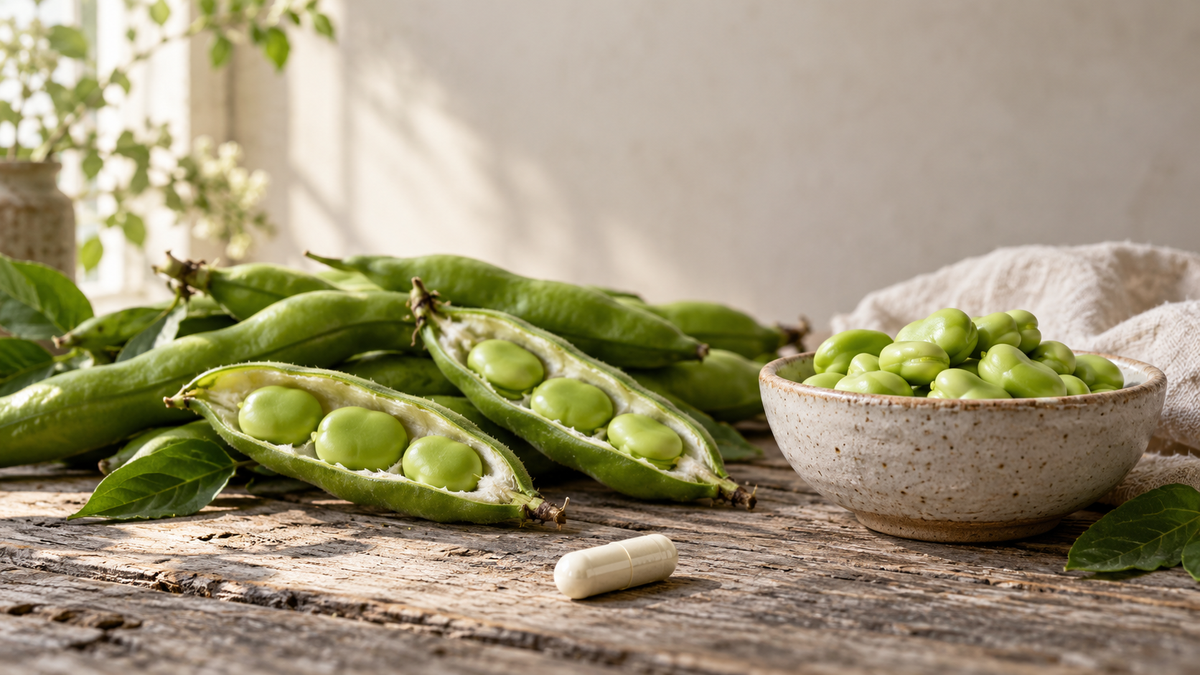
Fresh fava beans come in thick green pods. Shell them, blanch briefly, then slip off the pale skin around each bean. Dried fava beans need soaking and longer cooking, and canned fava beans are ready to use. They work in salads, pasta, stews and spreads.
Who should avoid fava beans
Fava beans are not for everyone. People with G6PD deficiency, an inherited enzyme condition that affects an estimated 400 million people worldwide, can develop a serious reaction called favism. Fava beans contain natural compounds called vicine and convicine, which the body converts into substances that can damage red blood cells in people who lack enough G6PD. Symptoms such as jaundice and dark urine can appear within hours, and cooking does not remove these compounds.
Fava beans also naturally contain levodopa. People taking MAO inhibitor medications have traditionally been advised to avoid them, so check with your physician or pharmacist if you take one.
From bean to muscle peptide
PeptiStrong was developed by breaking fava bean protein down into a specific network of short peptides, identified with the help of artificial intelligence. It is a defined ingredient, made to a consistent specification, so eating fava beans does not deliver the same thing. In December 2024, the FDA responded with no questions to a GRAS notice for PeptiStrong in foods at 2.4 g per serving.
In human trials, 2.4 g a day supported better strength recovery after a hard workout in a 2023 study of 30 men, and in a 2025 study of 72 men and women it produced greater gains in leg strength and muscular endurance than placebo alongside 56 days of resistance training. Our explainer, what is PeptiStrong, has the full story.
Who should check with a physician first
If you have G6PD deficiency or a history of favism, talk to your physician before eating fava beans or using any fava-derived product, including PeptiStrong. Also check with your physician if you have a legume allergy, take an MAO inhibitor or other prescription medication, or are pregnant, breastfeeding or under 18.
How Vita Bloom fits
Our PeptiStrong Muscle Peptides deliver 2.4 g of PeptiStrong® in four vegetarian capsules a day, as the only active ingredient. Take them daily with water, alongside resistance training, and give it at least eight weeks.
Frequently asked questions
Are fava beans healthy?
For most people, yes. They are rich in plant protein, fiber and folate. People with G6PD deficiency should avoid them.
How much protein is in fava beans?
About 13 g per cooked cup, according to USDA data.
Who should not eat fava beans?
People with G6PD deficiency or a history of favism, and people taking MAO inhibitor medications unless their physician says otherwise.
Do fava beans give the same benefits as PeptiStrong?
No. PeptiStrong is a specific peptide network made from fava bean protein and tested at 2.4 g a day. Eating whole fava beans is healthy, but it is not the same ingredient.
PeptiStrong® is a registered trademark of Nuritas Ltd. Vita Bloom Labs uses the branded ingredient and is not otherwise affiliated with Nuritas.
These statements have not been evaluated by the Food and Drug Administration. This product is not intended to diagnose, treat, cure, or prevent any disease.
Educational information, not personal medical advice. Ingredient research does not establish that a finished supplement treats or prevents a disease. Follow your product label and ask your healthcare professional about personal suitability.
Questions or a suggested correction? →


Leave a comment
This site is protected by hCaptcha and the hCaptcha Privacy Policy and Terms of Service apply.