Paraxanthine and L-Theanine: Do They Work Together?
In this article
If you have spent any time in nootropic or focus-supplement forums, you have run into the caffeine and L-theanine pairing. It is probably the single most recommended combination in the category. So the obvious question, once you switch to paraxanthine, is whether the same logic carries over.
Here is the honest answer, which is more interesting than a simple yes.
What L-theanine actually is
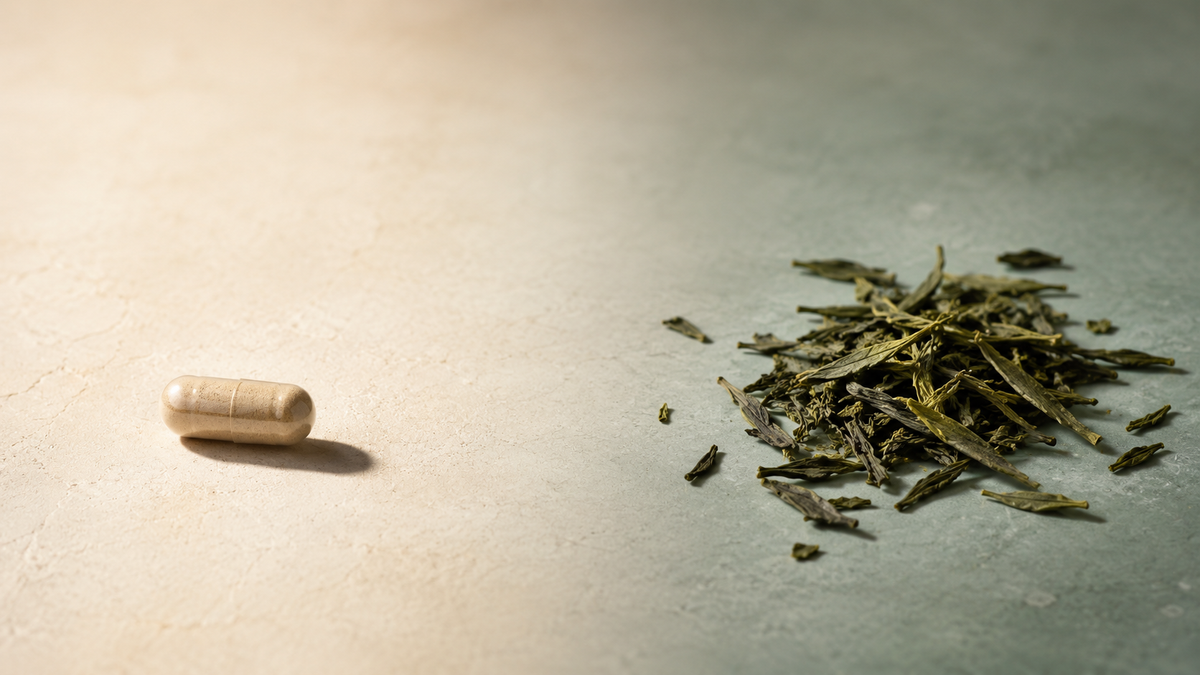
L-theanine is an amino acid found in tea leaves, particularly green tea. It is not a stimulant. On its own it does not make you alert, and anyone who tells you it does is describing something other than what the research shows.
What it has been studied for is a calm, settled quality of attention. In the research it is most often described as promoting relaxation without sedation, which is an unusual combination and the reason it became interesting to people looking for focus support.
The pairing everyone recommends is caffeine plus L-theanine
This is the crucial detail, and it gets lost constantly. Nearly all of the research behind the famous "stack" studied caffeine and L-theanine together, typically using something in the range of 100 to 200 mg of L-theanine alongside a moderate caffeine dose. Studies have looked at measures of attention and alertness, and the general finding is that the pairing performs differently than either component alone.
The popular explanation is that L-theanine smooths the edge off caffeine. That is a reasonable summary of why people like it. It is not a claim that the combination treats anything.
So does that transfer to paraxanthine?
Here is where we are going to be straighter with you than most supplement brands would be: we do not know, because the direct research does not exist.
The published work is on caffeine plus L-theanine. There is not a meaningful body of human research on paraxanthine plus L-theanine specifically. Anyone presenting that pairing as a studied, established stack is extending findings from one molecule to a different one and hoping you do not check.
There is a reasonable mechanistic argument for why it might behave similarly. Paraxanthine is caffeine's primary metabolite, the two are structurally close, and both block the same adenosine receptors. So the compounds are not strangers to each other.
But "mechanistically plausible" and "demonstrated in humans" are different standards, and we would rather name the gap than paper over it. If you try the combination, you are running a sensible experiment on yourself, not following an evidence base.
Paraxanthine vs L-theanine: they are not alternatives
Worth clearing up, because the comparison gets framed as a versus and it is really not one. These two do different jobs.
| Paraxanthine | L-theanine | |
|---|---|---|
| What it is | The primary metabolite of caffeine | An amino acid found in tea |
| Alerting on its own? | Yes, it is a stimulant metabolite | No |
| Studied for | Alertness, reaction time, cognitive measures | Relaxation without sedation, calm attention |
| Affects sleep timing? | Yes, take it earlier in the day | Not a stimulant, so timing is less constrained |
If you are choosing between them, you are probably asking the wrong question. If you want alertness, L-theanine alone will not deliver it. If you want a settled quality of attention without a stimulant, paraxanthine is not what you are after.
If you want to try the combination
A few sensible ground rules, keeping in mind this is self-experimentation rather than a protocol:
- Change one thing at a time. Take paraxanthine on its own for a week or two first so you know its baseline effect for you. Adding two new variables at once tells you nothing about either.
- Follow each product's label. Take the serving size printed on each, and do not open or split capsules to build your own ratio.
- Keep the timing rule. Paraxanthine is alerting, so it belongs earlier in the day regardless of what you pair it with.
Separate products or one capsule?
There are two sensible ways to take a stimulant with L-theanine, and they suit different goals.
Separate products let you build the combination yourself, at doses you can see, one variable at a time. That is the right approach for paraxanthine and L-theanine, because that specific pairing has not been studied and you will want to know which ingredient is responsible for anything you notice.
A fixed-ratio capsule makes sense when the pairing itself is the well-studied part. Caffeine with L-theanine has been tested in a series of randomized trials, most often at about one part caffeine to two parts L-theanine, so building that ratio into every capsule simply makes the classic pairing easy to take consistently.
How Vita Bloom fits
| Product | Vita Bloom Labs Enfinity® Paraxanthine (Clean Energy) |
|---|---|
| Per serving | 200 mg Enfinity® paraxanthine |
| Serving and form | 1 capsule, vegetable cellulose (vegan), unflavored; 30 capsules, 30 servings |
| How to take | One capsule in the morning or 30 minutes before demanding work. Avoid within 6 hours of bedtime. |
We make the paraxanthine half. Our Enfinity Paraxanthine provides 200 mg of paraxanthine per capsule as the only active ingredient, with no sweeteners, no stacked stimulants, and no proprietary blend. Our paraxanthine comes on its own, so to try it with L-theanine you would add an L-theanine product separately. If you would rather have L-theanine already paired with a stimulant, Caffeine 2.0 + L-Theanine, the Vita Bloom Labs caffeine and L-theanine supplement, combines 22.5 mg of patented Deura9® d9-caffeine, a longer-lasting form of caffeine, with 50 mg of L-theanine in every capsule. Our guide to d9-caffeine and L-theanine explains why that pairing fits.
See Enfinity Paraxanthine, or read the fuller comparison in paraxanthine vs caffeine. For the broader landscape, caffeine alternatives for focus covers where L-theanine sits among the other options.
Safety
L-theanine is generally well tolerated in healthy adults at the amounts used in research. Paraxanthine is a stimulant metabolite and should be treated as one: follow the serving size on the label and avoid it late in the day if you are sensitive.
Talk to your physician before combining supplements if you are pregnant, nursing, under 18, take prescription medication, or have a heart condition, high blood pressure, an arrhythmia, or an anxiety disorder. Combining supplements, or adding them to prescription medication, can cause interactions that are not obvious, and a pharmacist is a good person to ask.
Frequently asked questions
Can you take L-theanine with paraxanthine?
People do, and there is no established reason it would be a problem in healthy adults at label doses. What does not exist is meaningful human research on that specific pairing, so treat it as self-experimentation rather than a studied protocol, and check with your physician if you take medication.
Is paraxanthine or L-theanine better?
They do different things, so the comparison does not really work. Paraxanthine is alerting; L-theanine is not a stimulant and is studied for a calm quality of attention. Which is right depends entirely on what you are trying to achieve.
Does L-theanine reduce the jitters from paraxanthine?
Paraxanthine on its own did not raise nervousness in a 2024 head-to-head trial with caffeine, so there may be less to smooth. The research on smoothing a stimulant with L-theanine is with caffeine, not paraxanthine, so we cannot tell you it does. It is a plausible extension given how closely related the two compounds are, but plausible is not the same as demonstrated.
How much L-theanine is used in research?
Studies of the caffeine pairing have commonly used something in the range of 100 to 200 mg of L-theanine. If you buy an L-theanine product, follow its label rather than a figure from an article.
Should I take them at the same time?
That is how the caffeine pairing has generally been studied. Because paraxanthine is alerting, the more important rule is keeping it to earlier in the day.
Deura9® is a registered trademark of Lennham Pharmaceuticals, Inc. under exclusive license to d9 Designs Inc.
These statements have not been evaluated by the Food and Drug Administration. This product is not intended to diagnose, treat, cure, or prevent any disease.
Educational information, not personal medical advice. Ingredient research does not establish that a finished supplement treats or prevents a disease. Follow your product label and ask your healthcare professional about personal suitability.
Questions or a suggested correction? →

Leave a comment
This site is protected by hCaptcha and the hCaptcha Privacy Policy and Terms of Service apply.